
AI Doesn’t Take the Stage: Why Live Music Stays Human
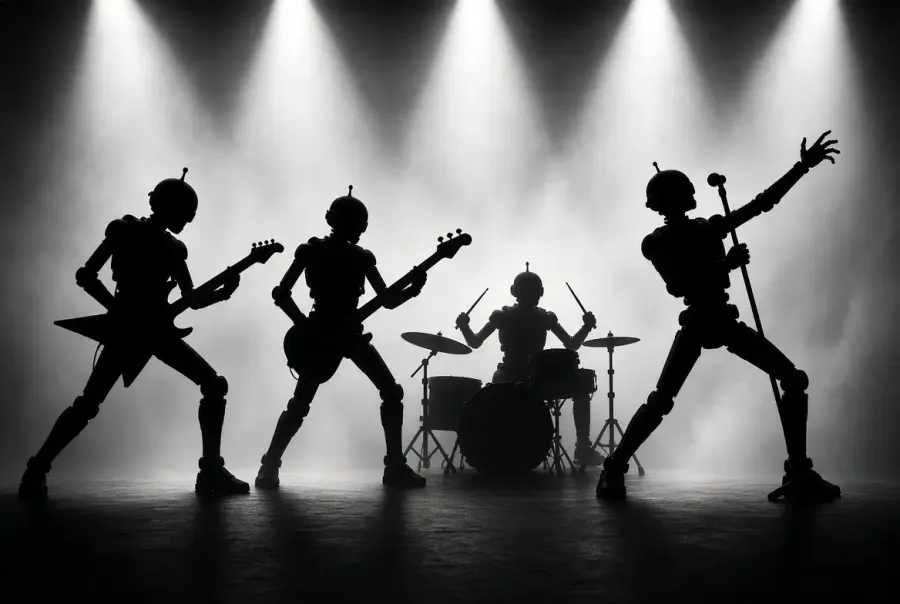
Artificial intelligence is already inside most musicians’ computers. It writes song drafts, suggests chord progressions, generates drum patterns and speeds up mixing. It works fast and never gets tired. But there is one thing it still cannot do: walk onto a stage, look people in the eye and make them feel that something real is happening right now.
Many artists already use AI as a practical assistant. It helps unlock a stuck song, test an idea in five minutes instead of an hour, or build a starting base. In those cases it is a useful tool, like a smarter metronome or an arranger that is always available. The problem starts when the tool gets confused with the person who actually plays.
“AI can copy a sound with surgical precision. It cannot invent the emotion of the moment.”
What Still Belongs Only to Humans
A live performance works precisely because it is not perfect. A slightly out-of-tune note, a sudden slowdown, a look between band members, the fatigue after two hours on stage: these things cannot be programmed. They are human. AI can reproduce a performance with millimetric accuracy, but it cannot create the intention, the risk or the tension that fills a room when everyone is breathing together.
That is why concerts have not disappeared. In a time when almost everything is digital and repeatable, people still pay to be present. They are not only looking for a song played well. They are looking for the chance that something unexpected and true will happen in front of them.
Real Questions, No Easy Answers
Serious questions remain. Who is the author of a song largely generated by an algorithm? Does it make sense to use automatic tools in contexts that celebrate authenticity? And if AI becomes extremely good at imitating certain technical gestures, what is left for the musician?
The answer is not total rejection of the technology, nor blind acceptance. AI can help in the studio, speed up preparation work and offer starting points. But the value of someone who plays live is still tied to things a machine does not have: presence, risk, relationship with the audience and with the other musicians on stage.
“The audience is not only buying a well-played song. They are buying the chance that something real will happen.”
What This Means for Independent Artists
For anyone who makes independent music and lives off dates, this is a concrete point. Venues and promoters are still looking for bands that bring real energy. Audiences are still looking for nights that cannot be downloaded. Tools like Band in Tour exist exactly to support this part of the job: connecting artists, venues and organisers through real dates, real profiles and real availability.
The map does not generate songs. It shows where people are playing and who is available to do it. AI can help write a track or mix faster. It cannot replace the relationship that forms when a band and a venue find each other, agree on terms and put on a show.
Use the Tool, Keep the Core
Artificial intelligence changes the way we prepare and produce music. It does not erase the reason people leave the house and go to a concert. As long as someone wants to be present in a room with other human beings while they play, live music will keep a place that no algorithm can occupy.
Band in Tour gives every side of the scene - bands, local artists, clubs, promoters and crew - the same map and the same tools to find each other. Artists post when and where they are free. Venues list open dates and room size. Promoters show the shows they have actually delivered. Scout Mode turns a simple need like “three dates in this area” into a short list of real options instead of another week of unanswered messages. The Live Music Club keeps the conversation inside the people who are already working.
“AI can speed up the work. It cannot replace the reason people still show up.”
Use the technology if it helps you. Just remember that on stage, at the end of the night, it is still you who counts. Put your real dates on the map, tag the people you actually work with, and keep treating every show as the human job it is. The venues and promoters who are looking for real energy need to be able to find you.
Discover live music near you
Band in Tour is where live music happens: browse the full event list, connect with artists, venues and promoters, for free.
Explore Band in Tour →

